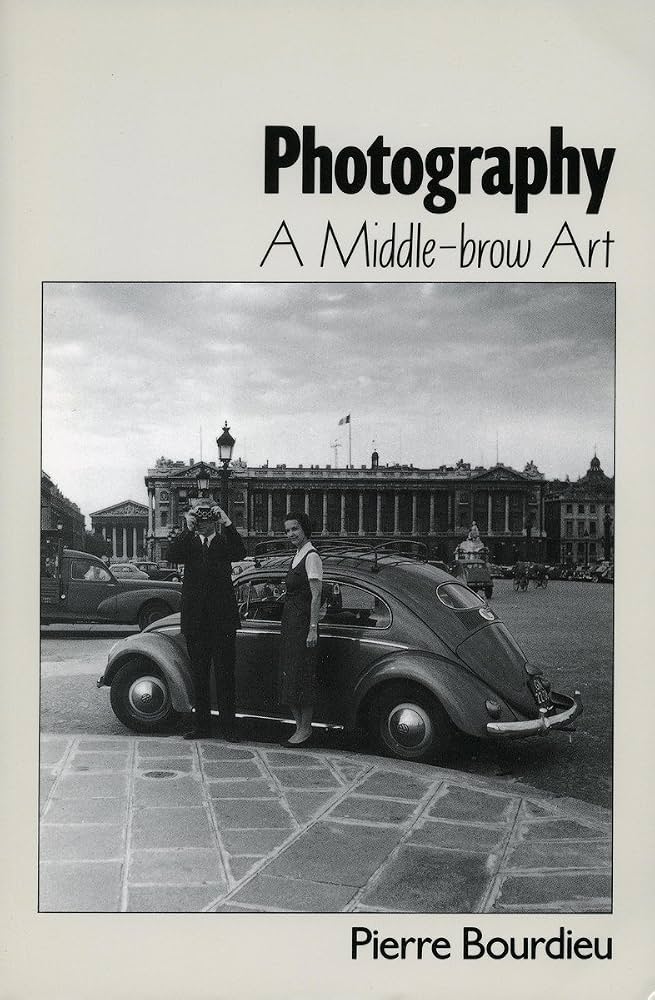
Pierre Bourdieu Photography A Middle-Brow Art
Pierre Bourdieu Photography A Middle-Brow Art


- 缺乏法定制度支持: 攝影不像繪畫、音樂或文學那樣,在當時擁有成熟的學院派體制、經典評審標準及嚴格的合法性認證。
- 技術門檻低: 任何人只要按下快門就能拍照,這種技術上的可普及性,使其難以像傳統高雅藝術(High Art)那樣天然具備彰顯精英身分的「排他性」。
- 大眾的可企及性: 它是一種人人都可參與、介於高雅文化與通俗文化之間的文化實踐。 [1]
- 勞動階級(Lower Classes)——功能主義導向: 基層大眾拍照主要是為了祭儀 solemnization 與家庭凝聚。他們在婚禮、節日或家庭團聚時拍照,目的是留下集體記憶與強化社會整合。對他們而言,照片的價值在於「拍了什麼」(功能與情感),而非「怎麼拍」(美學形式)。 [1, 2, 3, 4]
- 資產階級與知識份子——美學與區隔(Distinction)導向: 為了擺脫攝影流於「俗氣」的家庭實用功能,攝影愛好者、相機俱樂部(Camera Clubs)和專業攝影師會極力追求技術的精準與美學的精緻。他們試圖透過拍攝不尋常的題材、運用複雜的構圖與光影,來賦予攝影「藝術尊嚴」,藉此宣告自己擁有更高的文化資本,與普通大眾劃清界線。 [1, 2, 3]
- 文化慣習(Habitus): 個人內化的社會結構與階級背景,在潛移默化中決定了你會選擇在什麼場景、對著什麼物件按下快門。
- 社會區隔(Social Distinction): 品味並非純粹客觀的美學判斷,而是一種階級鬥爭的場域。人們透過對文化產品(如攝影)的消費與評判方式,來標榜自身的社會地位。 [1, 2, 3]
The book Photography: A Middle-Brow Art (original French work Un art moyen published in 1965) by Pierre Bourdieu, a master of French sociology, is a classic of cultural sociology and image research. Boudieu pointed out in the book that the public's seemingly unique and spontaneous daily photography behavior (such as family photos, travel records, wedding photography, etc.) is actually deeply constrained and systematically shaped by social class, group norms and cultural habits (Habitus)**. [1, 2, 3, 4, 5]
The core arguments and sociology insights of this work mainly cover the following three dimensions:
1. Why "Middle-Brow Art"?
Boudieu defines photography as "middle-class art" (or translated as sub-class art, popular art), because its positioning in the cultural class is extremely awkward: [1]
Lack of legal system support: Unlike painting, music or literature, photography had a mature academic system, classic evaluation standards and strict legality certification at that time.
Low technical threshold: Anyone can take photos as long as they press the shutter. This technical popularity makes it difficult to have the "exclicivity" of highlighting the elite identity as naturally as traditional high art.
Public accessibility: It is a kind of cultural practice that everyone can participate in, between elegant culture and popular culture. [1]
2. The social function and class practice of photography
The book combines anthropology observation and questionnaire survey to reveal how different social classes show completely different "tastes" and social needs through photography: [1, 2]
Working Class (Lower Classes) - Functionalism orientation: Grassroots public photography is mainly for solemnization and family cohesion. They take photos at weddings, festivals or family reunions in order to leave collective memories and strengthen social integration. For them, the value of photos lies in "what is taken" (function and emotion), not "how to take it" (aesthetic form). [1,2,3,4]
Bourgeoisie and Intellectuals - Aesthetics and Distinction Orientation: In order to get rid of the "tacky" family practical function of photography, photography enthusiasts, Camera Clubs and professional photographers will strive to pursue the precision of technology and the exquisiteness of aesthetics. They try to give photography "artistic dignity" by shooting unusual subjects and using complex compositions and light and shadow, thus declaring that they have higher cultural capital and drawing a clear line with the general public. [1, 2, 3]
3. The foundation of the core sociology concept
This book is an important milestone in the early development of Boudieu's core theory, and laid the empirical foundation for his later weight-level masterpiece "Separation: Social Criticism of Taste Judgment": [1]
Cultural habit (Habitus): The social structure and class background of personal internalization, in the subtlety, determine which scene you will choose to press the shutter on and what object.
Social Distinction: Taste is not a purely objective aesthetic judgment, but a field of class struggle. People promote their social status through the consumption and judgment of cultural products (such as photography). [1, 2, 3]
To sum up, Boudieu broke the romantic myth that "photography is free creation" through this work, proving to the world that how our lens focuses actually depends on our position in the social structure. [One, two]
庫存不足:剩餘 1 件
無法載入取貨服務供應情況