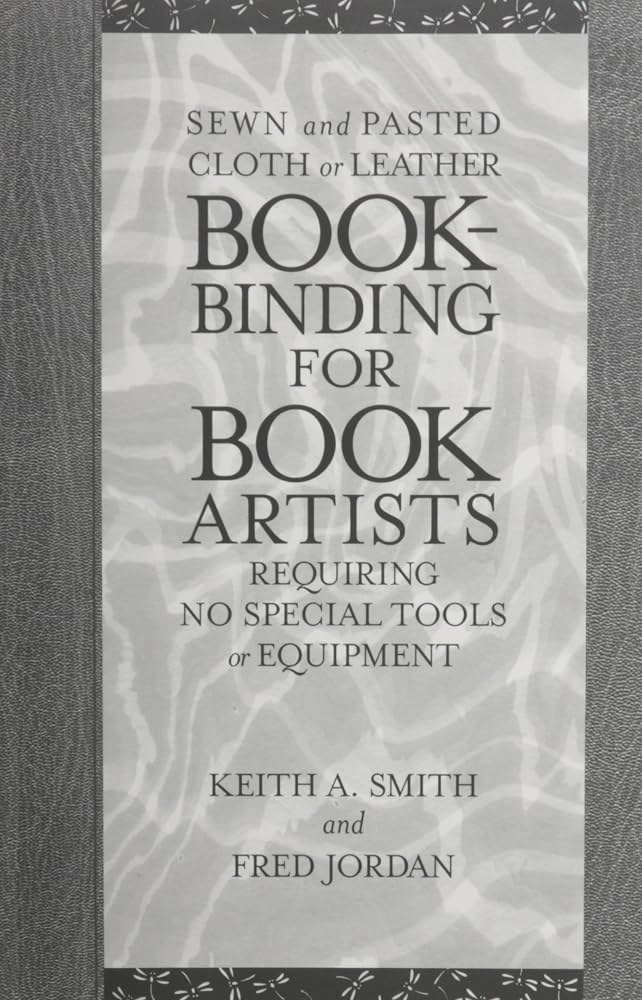
Keith A.Smith And Fred A.Jordan Sewn And Pasted Cloth Or Leather Book-Binding For Book Artists (Requiring No Special Tools Or Equipment)
Keith A.Smith And Fred A.Jordan Sewn And Pasted Cloth Or Leather Book-Binding For Book Artists (Requiring No Special Tools Or Equipment)
- 帶書板的冊頁裝訂 (Pamphlet Binding with Boards)
適合頁數較少、結構輕巧的書冊。指導讀者如何將簡單的單疊(Signature)針線縫書結構,與堅固的硬書板結合,呈現出精緻的封面質感。 - 平脊精裝 (Flat Back / Cased Binding)
現代最常見的精裝書形式。書脊呈平直狀,書芯縫合後與預製好的硬皮書殼(Case)組合黏貼。這是學習製作標準布面硬皮書的必修基礎。 -
緊脊精裝 (Tight Back / Rounded and Backed Leather Binding)
以製作經典的「四分之一皮革裝訂書」(Spine為皮革,封面為布面或裝飾紙)為目標。書脊經過圓脊(Rounding)與起線(Backing)處理,且封面皮革或布料直接黏貼在書脊上,隨書本開合而連動。 [1, 2]
- 免除削皮工序 (Eliminates Leather Paring):傳統皮面裝訂必須用特製削皮刀將皮革邊緣削得極薄,否則包裹書板時會顯得臃腫。本書教導讀者如何直接選用厚度適中、不需高難度削皮技巧的皮革來完成完美的邊角包裹。
- 簡化手工織帶 (No Hand-sewn Endbands):免去了在書脊兩端手織絲線堵頭布(Endbands)的複雜程序,改用更聰明、視覺效果同樣精緻的替代方案。
- 無專門設備需求:書中介紹的壓實、縫合、刷膠等工序,皆可利用生活常見物(如重書、G字夾、普通美工刀、手縫針)代替專業木製裝訂壓機,非常適合個人工作室或居家創作。 [1, 2, 3]
- 主要作者:Keith A. Smith(著有多本著名的無膠裝訂《Non-Adhesive Binding》系列書籍)及 Fred A. Jordan
- 出版年份:1998 年首版(2000 年再版)
- 頁數:424 頁,附帶豐富的實物照片、工序插圖、詞彙表以及材料選購指南 [1, 2, 3, 4, 5]
Sewn and Pasted Cloth or Leather Bookbinding for Book Artists (Requiring No Special Tools or Equipm Ent) (also commonly known as "Bookbinding for Book Artists") is a book artist Keith A. Smith and Fred A. Jordan published a guide to the practical revision of classics published by Jordan in 1998. This book is specially designed for non-professional bookmakers, artists and handicraft enthusiasts. The core purpose is to break the high technical threshold of traditional hardcover books and leather binding, so that readers do not need to buy expensive professional tools (such as heavy presses, leather knives, etc.), and they can also produce cloth or leather hard books with excellent quality at home. [1, 2, 3]
Three core major revisions
This book deeply analyzes the hard-skinning techniques of the three classics with extremely detailed steps, photographic illustrations and structural lines: [1, 2]
Pamphlet Binding with Boards
A fairly light book with fewer suitable pages. Instruct readers how to combine a simple single-folded (Signature) needle-line stitching book with a solid hard bookboard to present an exquisite cover texture.
Flat Back (Flat Back / Cased Binding)
The most common hardcover format in modern times. The spine of the book is flat and straight, and after the book core is sewn, it is glued with a well-made hard leather book case (Case). This is the required basics for learning and making standard cloth hard leather books.
Tight Back (Tight Back / Rounded and Backed Leather Binding)
Aim to produce the classic "quarter leather binding book" (Spine is leather, cover is cloth or decorative paper). The spine is rounded and backed, and the cover leather or fabric is directly glued to the spine and connected with the opening and closing of the book. [1, 2]
Subverting the traditional "painless" installation method
The traditional leather hardcover process is extremely complicated and demanding, and the biggest feature of this book is the simplification of the key points:
Exemption from peeling process (Eliminates Leather Paring): The special leather knife, which is required for traditional leather surface installation, scrapes the edge of the leather to be extremely thin, otherwise it will appear swollen when wrapping the book board. This book teaches readers how to directly choose the right thickness, without the need for high-difficulty leather to complete the perfect angular wrap.
Simplified hand-woven bands (No Hand-sewn Endbands): The complex process of hand-woven endbands (Endbands) at both ends of the spine is removed, and an alternative with a smarter and more exquisite visual effect.
No specialized equipment requirements: pressing, sewing, glue brushing and other processes introduced in the book, everyone can use everyday common objects (such as heavy calligraphy, G-shaped clip, ordinary beauty knife, hand sewing needle) instead of professional wooden assembly press, which is very suitable for personal studios or home creation. [1, 2, 3]
Basic information of the book
Main author: Keith A. Smith (author of many famous glue-free books "Non-Adhesive Binding") and Fred A. Jordan
Year of publication: 1998 first edition (reprinted in 2000)
Number of pages: 424, with abundant physical photos, process illustrations, vocabulary tables and material selection guidelines [1, 2, 3, 4, 5]
This book is a must-read bridge for hand-made book creators to move from "paper-based soft leather books" to "high-quality fabric/leather hardcover". It has a considerable solemnity and the flexibility of amateur creation.
Low stock: 1 left
Couldn't load pickup availability